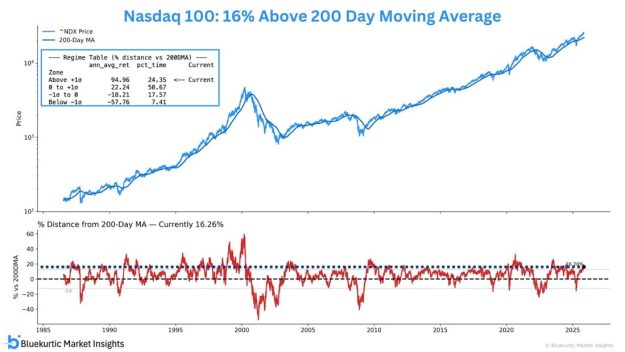
A two-panel chart showing the Nasdaq 100 price versus its 200-day moving average since 1985. The top panel plots the index and its 200-day MA, along with a box showing four return regimes based on distance from the 200-day MA. It highlights that the current reading is about 16% above the 200-day MA, placing it in the “Above +1 standard deviation” zone, which historically delivered the highest annualized returns. The bottom panel shows the percentage distance of the Nasdaq 100 from its 200-day MA over time, with dashed lines marking one standard deviation above and below. The latest value is labeled at roughly +16%. Branding “© Bluekurtic Market Insights” appears at the bottom.

Market Mania – FinX Weekly Top 10 #18

“If there is such a thing as “up is bad”, it’s when the HLL Indexes are doing this and break into warning levels. Both are currently at their respective “high alert levels” (NYSE HLL is a warning above 1.50). It is important to keep in mind, however, warnings can survive many, many months before the indices actually render a larger correction/pullback/bear market.”

October Monthly QUANT Recap

October closes not just with a flurry of headlines or policy speculation but with the market continuing to write its own script atop sturdy earnings growth, resilient margins, and relentless upward price action. The S&P 500 has scaled to its 34th all-time high this year, with October delivering a weekly gain and fulfilling a stretch that, historically, sets the market up for further highs before year-end. Finom Group’s research underscores that these highs have come not through happenstance, but by way of methodical price action, disciplined dip buying, and persistent earnings upgrades—even as anxieties swirl over policy and politics.

Technical Warning Signals Forming and Informing

Finom Group’s chief market strategist Seth Golden rarely offers a free public article denoting macro-market conditions, trends, or personal insights. Our best-in-class macro-market Research Reports 🔬, which are published solely for Finom Group institutional and retail investing clientele are so detailed, in depth, and undeniably an effective means for making capital allocation decisions that we…

Market Mania – FinX Weekly Top 10 #17

“I don’t use volume very often. The only really good use for volume is to identify washouts. It’s the main thing it helps you with. You know, you’ll always hear people say, “Oh, the market went up, up, up on light volume.

That’s all it ever does. That’s called a melt-up. That’s what markets do — they generally have lighter volume on the upside and heavier volume on the downside.

It’s what investing is all about. You get lighter volume on the upside because buying is a process — it’s slower and takes more consideration, so it doesn’t happen all at once. Selling is quite the opposite — it usually happens all at once because something is scaring investors.

It’s an emotional response. It doesn’t take a lot of time; you’re scared, so you sell. So, there’s almost always greater volume on the downside.

SEPTEMBER FINOM GROUP MONTHLY MACRO-MARKET QUANT RECAP

September Monthly Macro-Market RECAP

September, notorious for its volatility and bearish lore, instead delivered yet another display of broad resilience and underlying macro strength. Contrary to pundits and headline fear, economic growth continued to surprise—with Finom Group’s long-standing no-recession call again borne out despite Q1’s “growth scare” and every new round of exogenous policy risk. With tariff realignments and labor disruptions receding, businesses adapted, consumption rebounded, and jobless claims trended toward new lows by month-end. In short: this cycle’s adaptability and productivity remain underappreciated by the consensus.

Market Mania – FinX Weekly Top 10 #14

“Markets are intrinsically constructed to go higher, not lower and investors largely position and participate for such outcomes. Hence, if there are quant probabilities informing of a greater than 70% downside probability, these still have a higher failure rate than quants informing of a greater than 70% positive outcome. In other words, always leave more room for negative quants to fail than positive quant failures. Markets are designed to go higher, which is the basis for investing.”

CME Fed Fund Futures Market FedWatch

Market Mania – FinX Weekly Top 10 #13

“In the face of pressure to lower rates, they’re going to lower rates.
They are.
Again, the rapidity doesn’t seem harmful. This is, unfortunately, political pressure that has the potential to cause trouble.
We might look back five, six, seven, eight months from now and say, “Oh, the Fed should have never cut rates.”
What kind of scumbag are you? The Fed should have never cut rates after beating the economy into submission?
This is how it always goes: the Fed is treated as if it’s perfect — 100% perfect in achieving desirable outcomes for the economy.
They’ve NEVER BEEN WRONG.
The only way we imagine them making mistakes is because we have the luxury of playing Monday-morning quarterback —
watching from the sidelines and looking at things in hindsight. They have to make the call in real time. We don’t.
We don’t have to cut rates, raise rates, or do nothing. They do.
So we critique. We lambast. We denigrate them to our heart’s desire. And we do.
We’ve got the “get out of jail free” card. They don’t. But that doesn’t change the fact that they’ve “never been wrong” — which is why we always call on the Fed to come to the rescue every single time.
And yet, it always unfolds this way: when they’re found at fault, it’s pinned on stupidity, negligence, or ignorance — not of monetary policy, but of fiscal policy.
Because here’s the truth: no matter what the Fed does, it can’t overcome the size or direction of fiscal policy.
The effectiveness of monetary policy is determined by fiscal choices.
The only entity with the real possibility of being wrong is on the fiscal side, not the monetary side.
Think about the function here: we’re calling on the Fed to do what? Save us from what?
From what we broke.
We break it on the fiscal side, and then we reach for the life preserver of monetary policy.”
– Seth Golden, Chief Market Strategist at FinomGroup.com

$MSTR - MicroStrategy (Daily Chart)

Market Mania – FinX Weekly Top 10 #12

“When it comes to looking at the the totality of the labor data, it demands context. It demands study….by all accounts, the labor market is in balance, almost perfect balance.
The major issue when it comes to what you hear versus what reality is versus maybe predicting the future is you\\\’re only going to be able to ascertain the reality through research, through looking at the data objectively.
And the reality behind the headlines is that while the labor market is in balance, that balance only includes creating possibly on average 50,000 jobs a month.
And you’re not going to find economists with the ability, the actual ability to appreciate 50,000 jobs on average a month when you’re coming from levels of 100, 150 to 200,000 a month. That doesn’t look strong.