
Market Mania – FinX Weekly Top 10 #22
“Discipline is rare because excuses are cheaper.”
– SETH GOLDEN, CHIEF MARKET STRATEGIST AT FINOM GROUP
“Discipline is rare because excuses are cheaper.”
– SETH GOLDEN, CHIEF MARKET STRATEGIST AT FINOM GROUP
“Investors are funny creatures! Amazes me how #investors are anxious to buy when market is green & scared to buy when market is red. What’s even funnier is investors will hedge in an uptrend, afraid of rising prices! 2 worst times to buy; price going up, price going down.”
“…the 50-DMA is holding… for now. How much longer remains to be seen but before my ADHD catches up with me, I’ll remind investors/traders that if Tech/Semis/Growth/QQQs can’t find a new wave of buying, we’re likely going to continue this consolidation phase and ultimately break below the 50-DMA. Need that leadership to lead, because of the cap-weighting within cap-weighted indices proves market moving. Good news on that front if we think in MAG-7 terms is offered in the chart of the ETF for the MAG-7 (MAGS)”
“I’m comfortable, despite the late year breadth and momentum consolidation underneath the surface of the markets, buying the dips hence forth and given the litany of quant data informing of higher prices by year-end. I can understand that many would not be as comfortable, given certain of the technical charts discussed, but do keep in mind that what is taking place is typical of strong bull markets initially executing a Zweig Breadth Thrust and everything rally to new all-time highs across almost all cap-tier levels and indices. That kind of bull market demands a breather, at least underneath the surface. There’s nothing ominous in the technicals, and just like a recession demands an exogenous/endogenous catalyst, I hold the view that such is the case with this bull market delivering a full 10% correction. Job growth has stalled, Mis are still below 50, yield-curve formerly inverted, Sahm Rule formerly triggered, Fed hiked at the fastest pace in 45 years and no recession. The demand for a catalyst to cause one is no different than what markets need to drive a full 10% or greater correction given the earnings strength and momentum trends. I’m not trying to tempt Mr. Market, but we had this same discussion to end October 2024, still yet without a full 10%+ correction on the year (-9.8%). That 10% correction didn’t come until the threat of severe tariffs in early 2025 ie an exogenous event.”
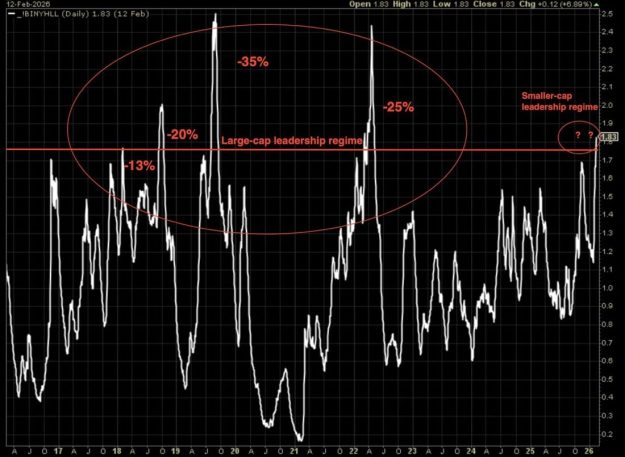
“If there is such a thing as “up is bad”, it’s when the HLL Indexes are doing this and break into warning levels. Both are currently at their respective “high alert levels” (NYSE HLL is a warning above 1.50). It is important to keep in mind, however, warnings can survive many, many months before the indices actually render a larger correction/pullback/bear market.”
October closes not just with a flurry of headlines or policy speculation but with the market continuing to write its own script atop sturdy earnings growth, resilient margins, and relentless upward price action. The S&P 500 has scaled to its 34th all-time high this year, with October delivering a weekly gain and fulfilling a stretch that, historically, sets the market up for further highs before year-end. Finom Group’s research underscores that these highs have come not through happenstance, but by way of methodical price action, disciplined dip buying, and persistent earnings upgrades—even as anxieties swirl over policy and politics.
“I don’t use volume very often. The only really good use for volume is to identify washouts. It’s the main thing it helps you with. You know, you’ll always hear people say, “Oh, the market went up, up, up on light volume.
That’s all it ever does. That’s called a melt-up. That’s what markets do — they generally have lighter volume on the upside and heavier volume on the downside.
It’s what investing is all about. You get lighter volume on the upside because buying is a process — it’s slower and takes more consideration, so it doesn’t happen all at once. Selling is quite the opposite — it usually happens all at once because something is scaring investors.
It’s an emotional response. It doesn’t take a lot of time; you’re scared, so you sell. So, there’s almost always greater volume on the downside.
“Act on local price weakness with a long-term mindset 🧠!
Make time ⏰ your best friend.”
Rule of thumb 👍
I don’t worry about a down day/market $SPX $QQQ when crap 💩 retail like $M and $KSS are higher in the same tape. I worry wether or not I’m recognizing the tells as opportunity!
“#Investing well is getting comfortable with being uncomfortable. You know you’ve accomplished this when you see down as good, up as simply better.” – Seth Marcus
September, notorious for its volatility and bearish lore, instead delivered yet another display of broad resilience and underlying macro strength. Contrary to pundits and headline fear, economic growth continued to surprise—with Finom Group’s long-standing no-recession call again borne out despite Q1’s “growth scare” and every new round of exogenous policy risk. With tariff realignments and labor disruptions receding, businesses adapted, consumption rebounded, and jobless claims trended toward new lows by month-end. In short: this cycle’s adaptability and productivity remain underappreciated by the consensus.